April 2026
Spravato® Scheduling and Observation Portal
Improve clinician workflow and operation logistics through a patient scheduling portal.

Platform
Role
Team
Myself, Product Designer, Product Manager, Director of Product
Outcomes
Delivered to pitch
Context
I was part of a product pitch competition lead by Amalgam RX to help improve clinic workflow and patient care logistics regarding Spravato® treatment. Spravato is a nasal spray used to treat adults with TRD or MDD who are normally treatment resistent to anitdepressents. Due to its 2-hour post treatment observation period, some clinicis are reluctant to administer Spravato®.
In 2 weeks, I designed a 2-sided clinic and patient scheduling and operational platform for a high constraint environment.
Impact hypothesis
Reduce manual coordination burden
Improve visibility into active monitored sessions
Help clinics use observation capacity more efficiently
Results
• Still waiting to hear results however the head of product and PM were excited for this pitch because of how my design supported patients outside of their appointments.

Overview
Goal
Design a multi facing portal for patients and healthcare providers scheduling and managing Spravato treatment.
Problem
Spravato treatment requires a 2-hour monitored observation period. One patient appointment involves managing limited stations, staff attention, timed check-ins, patient arrivals, and medication supply – leading clinic to be relutant to administer the treatment.
The Challenge
Design a 2 sided appointment scheduling experience that influenced each other but also impacted by factors such as supply management, timed check ins, and limited stations.
My approach
At the start of the project, I was given a brief of how the head of product envisioned the final product. I focused on 4 principles:
Make treatment states visible
Schedule around station capacity, not just time
Keep staff in control of critical actions
Sync booking, monitoring, and supply planning
Key decisions
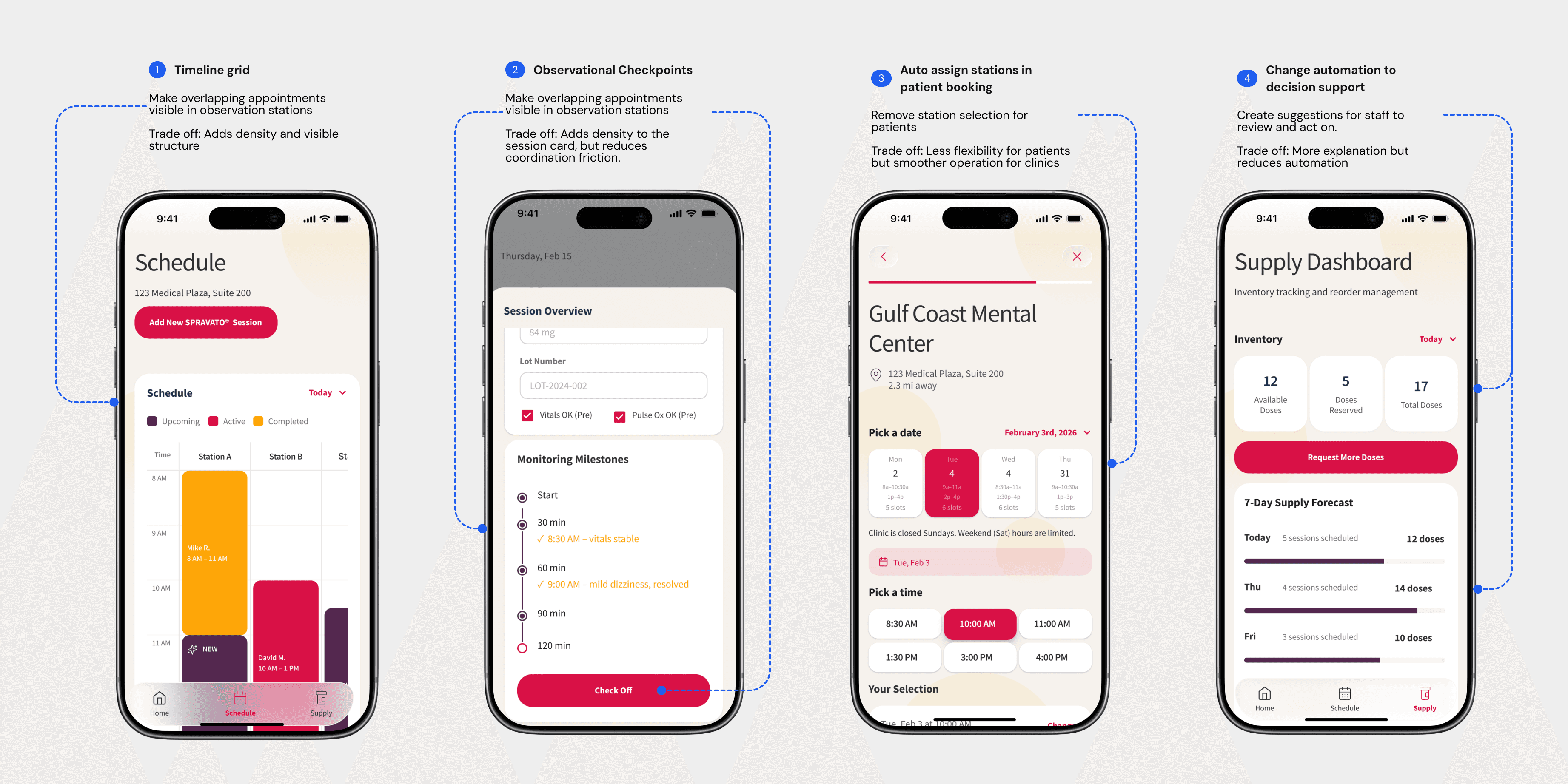
Timeline grid over a standard calendar
I used a station-by-time grid so staff could see true clinic capacity and overlapping monitored sessions.
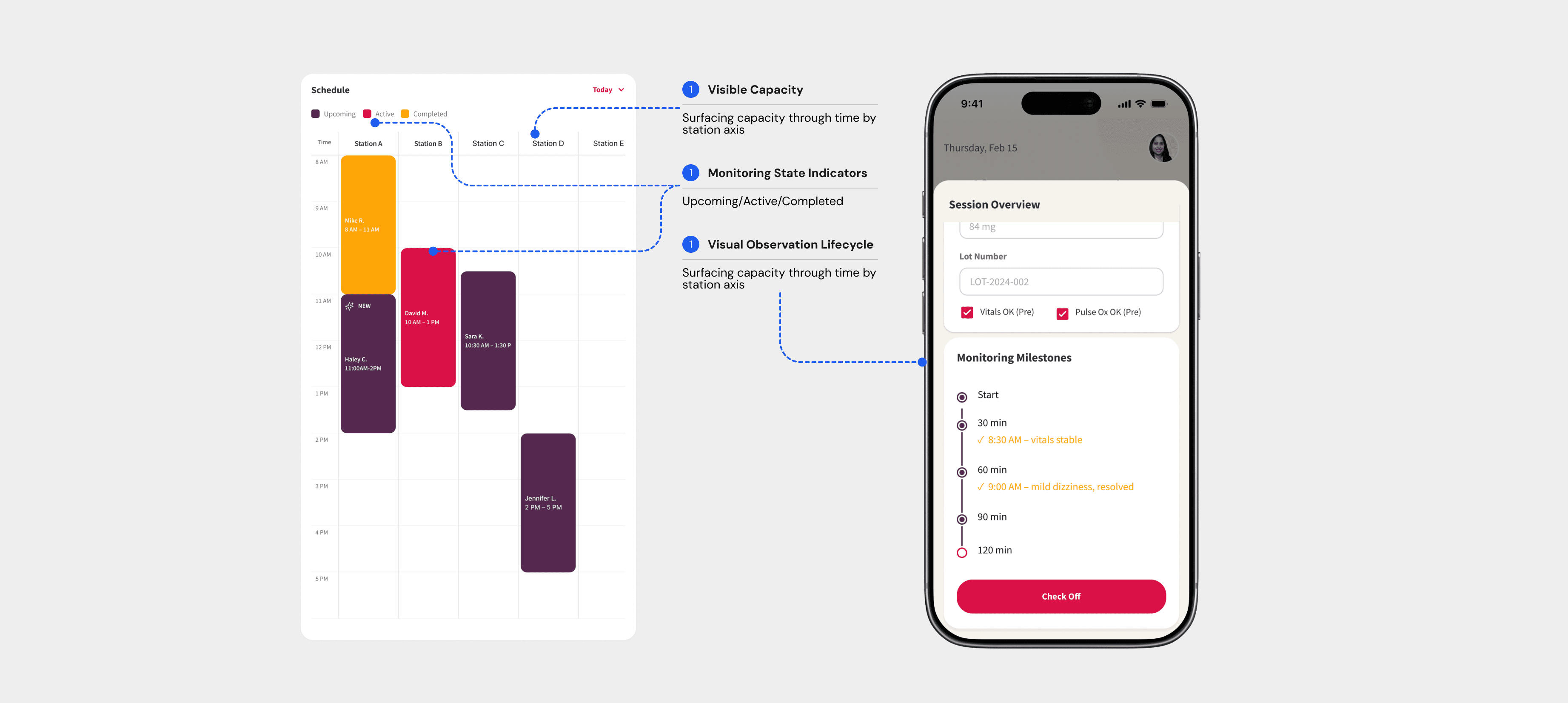
Horizontal check in vs live session monitoring
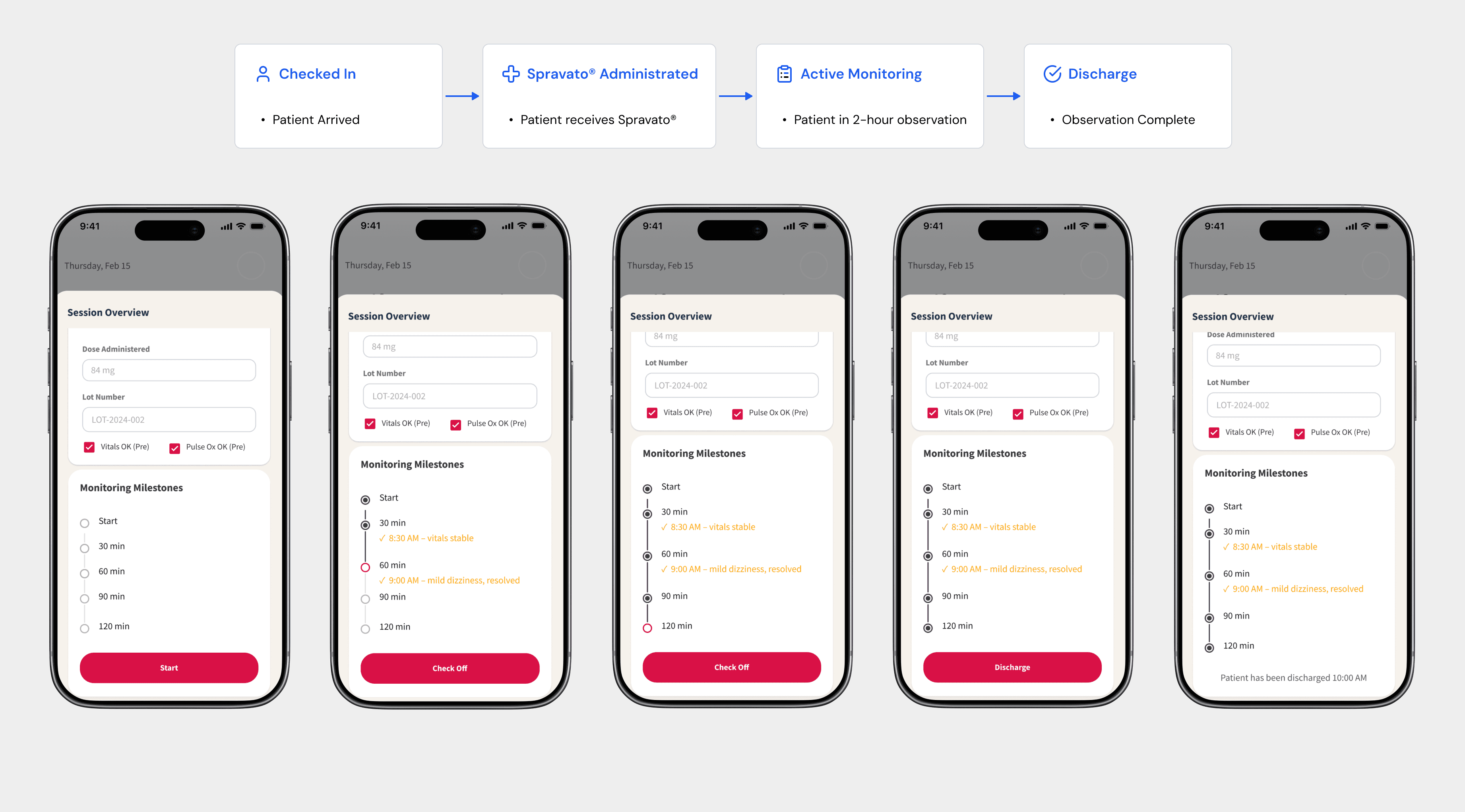
I embedded timers and required 30/60/90/120-minute check-ins into each active session so staff could track progress without jumping between tools.
Constrained patient self-booking
Patients could self-book only within clinic-defined rules so convenience did not create operational risk.
Decision support, not full automation
Staffing and reorder suggestions were framed as recommendations staff could review and act on.

Solution
Why the workflow mattered to clinics
That tension shaped the product strategy. The platform needed to help clinics do three things at once:
keep monitored treatment workflows safe and visible,
make operational capacity easier to plan and use,
reduce the amount of manual coordination staff needed to do across scheduling, observation, supply, and patient communication.
Modeling the treatment ecosystem
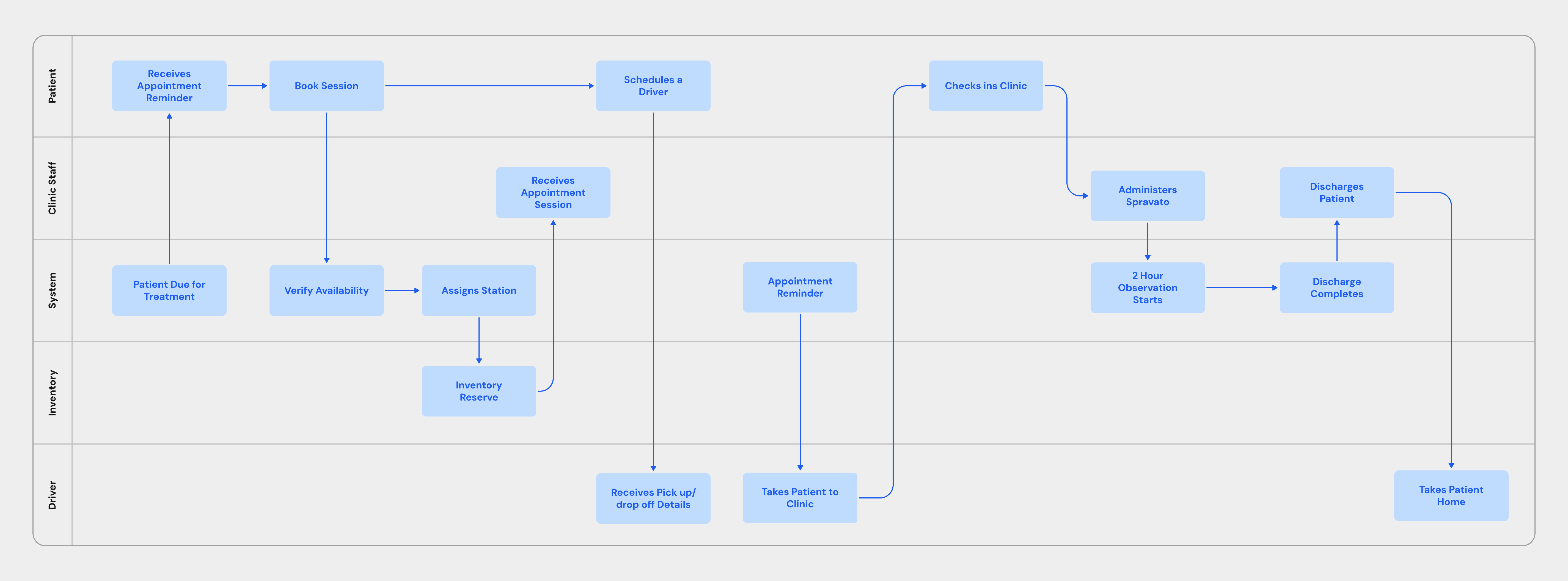
Rather than treating this as a single-user interface problem, I mapped the workflow as a coordinated system across multiple actors:
Patient
Receives invitation, books a session, prepares for arrival, checks in, completes monitoring, and arranges transportation.
Clinic staff / coordinator
Schedules sessions, confirms capacity, assigns stations, tracks observation progress, handles exceptions, and communicates with patients.
Monitoring staff
Oversee active sessions, complete required check-ins, and confirm discharge readiness.
Clinic manager
Monitors utilization, staffing pressure, and upcoming inventory demand.
I also mapped the key system objects that drive the workflow:
Session
Observation station
Appointment time
Monitoring checkpoints
Discharge state
Dose inventory
Transportation status
Where the workflow broke down
As I decomposed the workflow, I found that the main friction points were operational, not visual.
1. Scheduling did not reflect actual treatment capacity
A standard appointment calendar treats time as the main resource. In this workflow, a clinic’s real capacity depends on both time and observation-station availability.
2. Active sessions were hard to monitor at a glance
Staff needed live visibility into which patients were in observation, which checkpoints were due, and when a session could be discharged.
3. Upstream patient actions affected downstream operations
Early arrival, lateness, cancellations, or self-booked appointments could impact staffing, station usage, and supply planning.
4. Inventory planning was disconnected from treatment demand
Each confirmed session should reserve supply, but cancellations and future demand shifts change the planning picture.
Design principles / strategy
I used four design principles to guide the system:
Make treatment state visible
Staff should understand the status of every active monitored session without opening multiple records.
Treat stations as first-class scheduling objects
Because observation capacity is constrained by physical stations, the system should schedule against both time and station availability.
Keep humans in control of critical actions
The system can assist with calculations and recommendations, but staff should stay in control of assignment, monitoring, and discharge decisions.
Synchronize upstream and downstream workflows
Patient booking, station allocation, inventory reservation, and reminders should stay connected so the clinic is not manually stitching together operational state.
Pivotal design decisions
Clinic operations dashboard
The clinic-facing dashboard centered on the day’s treatment schedule. Staff could view sessions across time and stations, see which patients were currently in observation, identify open capacity, and add new sessions without losing context.
When staff created a new session, they selected a patient, assigned a station, and the system automatically calculated the observation end time based on the treatment workflow. This reduced manual time calculation and made downstream discharge timing visible from the start.
Live observation workflow
Suggested narrative
The live monitoring layer turned each active treatment into a trackable session state. Staff could see a countdown timer, upcoming required checkpoints, and whether monitoring milestones had been completed.
This changed the dashboard from a passive schedule into an active operational tool. Instead of asking staff to remember where each patient was in the observation timeline, the system externalized that cognitive load and made discharge readiness visible.
What to show
A detailed annotated screen with:
countdown timer
checkpoint states
overdue state
discharge-ready state
exception states
Patient booking experience
On the patient side, I introduced guided self-scheduling through a web/mobile portal. Patients received an email or SMS link, selected a clinic, viewed eligible time slots, and booked a session. After booking, they received reminders, arrival prompts, and a way to notify the clinic if they were running early or late.
This improved convenience for patients, but more importantly, it reduced administrative coordination by ensuring appointments entered the clinic workflow in a structured way. Once booked, the session appeared on the clinic dashboard and could be assigned to a station by staff.
Inventory and demand planning
I also designed a lightweight planning layer that linked confirmed sessions to inventory demand. Each confirmed appointment reserved one dose, and cancellations released supply back into availability. The dashboard forecasted demand against available stock over the next seven days and surfaced reorder alerts when projected inventory dropped too low.
I positioned this as an operational planning tool rather than a standalone inventory system. Its purpose was to help clinics anticipate treatment demand based on upcoming bookings and reduce the risk of manual supply planning errors.
Transportation support
Because patients may require transportation to and from treatment, I extended the workflow to include ride coordination. This acknowledged that treatment logistics do not end when an appointment is booked. Transportation timing affects arrival, discharge readiness, and the overall coordination burden on staff.
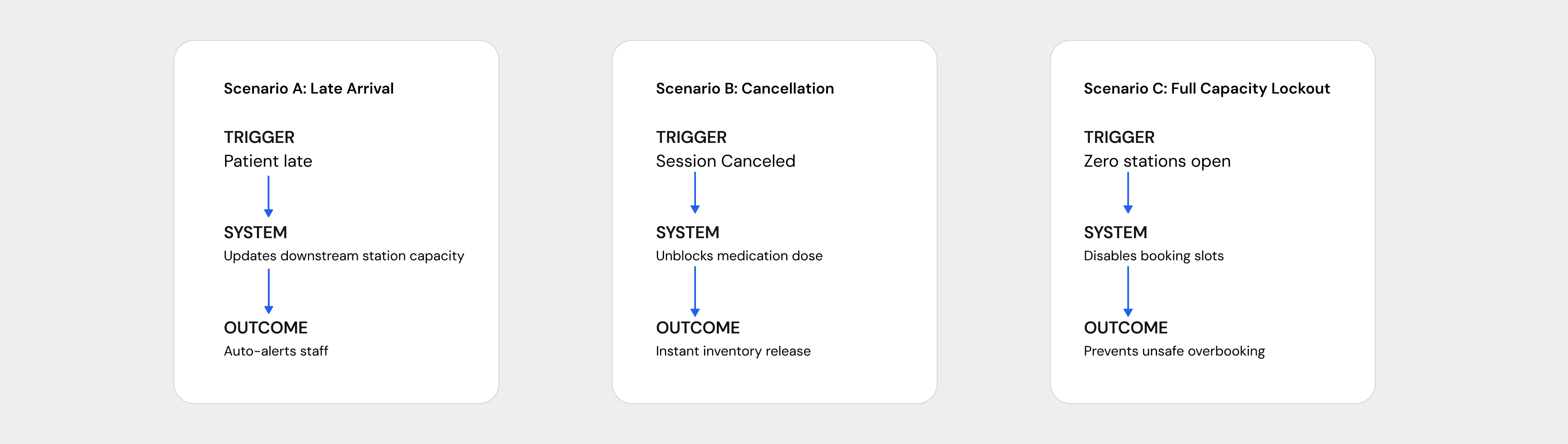
Designing for failure and operational risk
I identified the highest-risk scenarios as:
Double-booked or unavailable stations
Incomplete observation checkpoints
Discharge before monitoring is complete
Patient self-booking into invalid operational capacity
I addressed these through a combination of workflow rules, visible status, and staff-controlled actions. The system automated calculations and surfaced recommendations, but kept staff in control of consequential decisions like station assignment, monitoring completion, and reorder action.
How I would validate the workflow
Because this concept coordinates a complex real-world service, I would validate it through scenario-based workflow testing rather than only interface usability testing.
The highest-priority scenarios I would test:
Adding a new session when only limited station capacity remains
Handling a late-arriving patient
Completing active observation with timed checkpoints
I would measure:
Time to create and assign a session
Error rate in identifying active session state
Missed or delayed checkpoint actions
Reflection
This project taught me that healthcare workflow design is less about making screens simple and more about making complex care operations visible, coordinated, and safe.
RELATED PROJECTS

