Nov 2026-Jan 2026
Medical Grade Conversation AI
Designing the generative conversation experience of a customer facing AI assistance for improved compliance, workflow, and strategic business outcomes.

Platform
Role
Team
Myself, Design Systems Designer, Animator, Data Scientist, Marketing, Product Manager, and Engineer
Outcomes
12% Drop-Off Decrease
Context
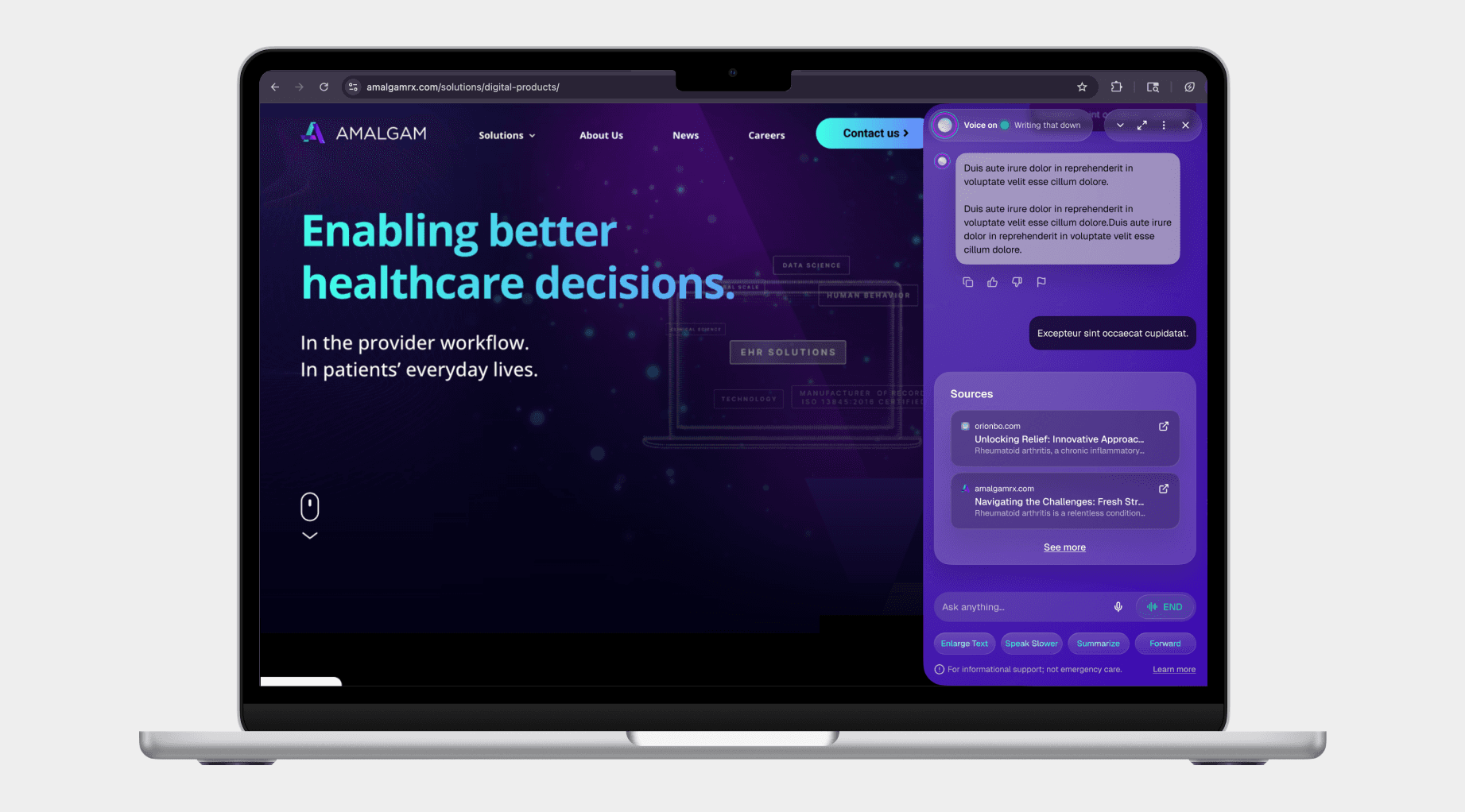
I was the lead UX and conversation designer and designed an end-to-end medical grade Voice & Text AI chat widget for Amalgam RX. The goal is to create a welcoming chat experience that tailors to the needs of Pharma Executives, Health Care Professionals, and Patients/Caregivers. For this 2 month project I handled the multi modal conversation design, prototyping, and medical grade UX design stratedgy.

Overview
Goal
Design a best-in-class medical grade voice & text conversational UX experience for Physicians, Patients, and Pharma executives.
Problem
Standard LLMs are not medical grade and the different user types require different forms of communication.
The Challenge
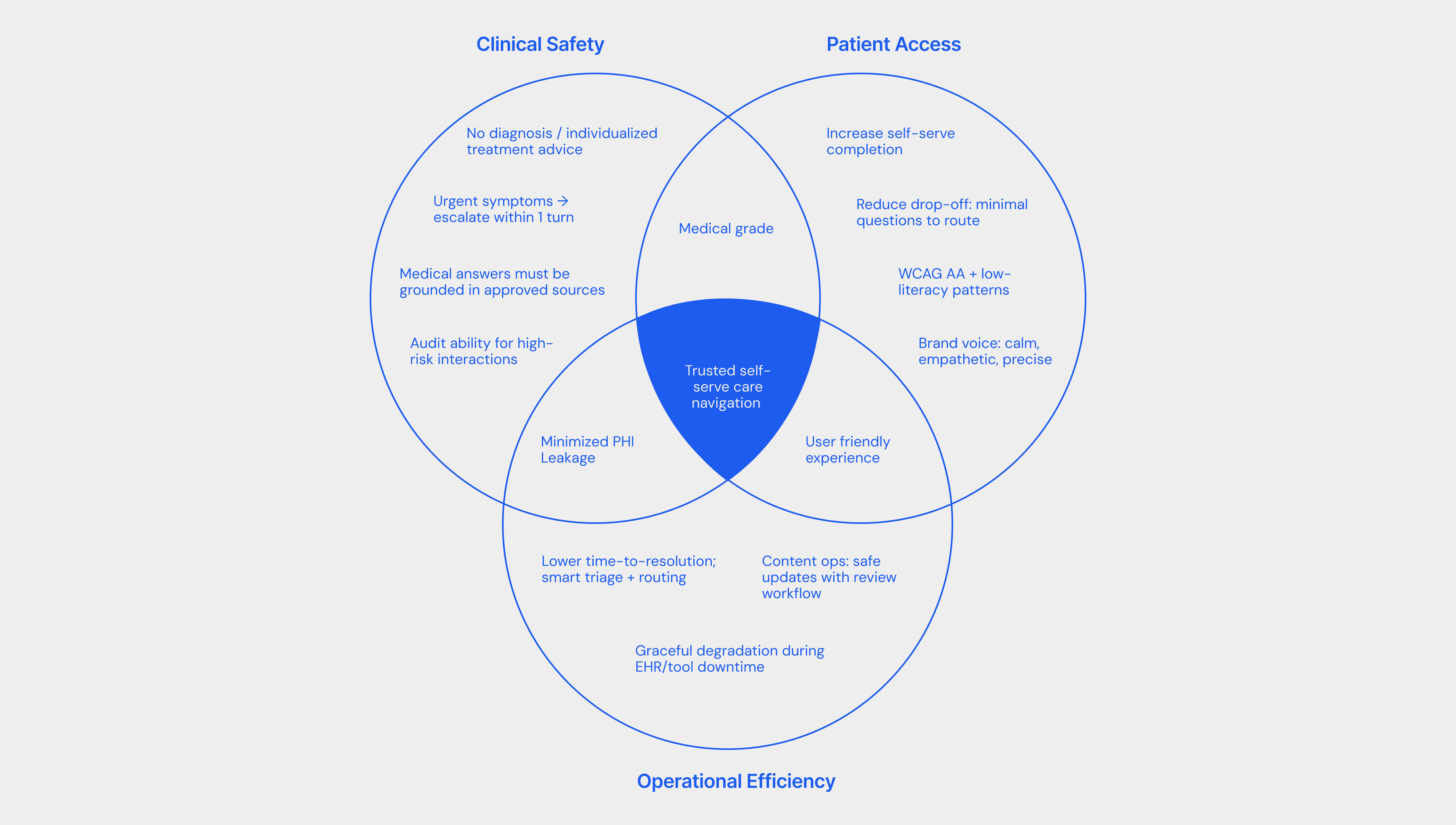
Design an experience operating strictly within “No Medical Advice” boundaries while maintaining high-trust safety signals, HIPAA constraints, and minimized PHI.
The Proof of Concept felt like an IVR Marketing Pitch
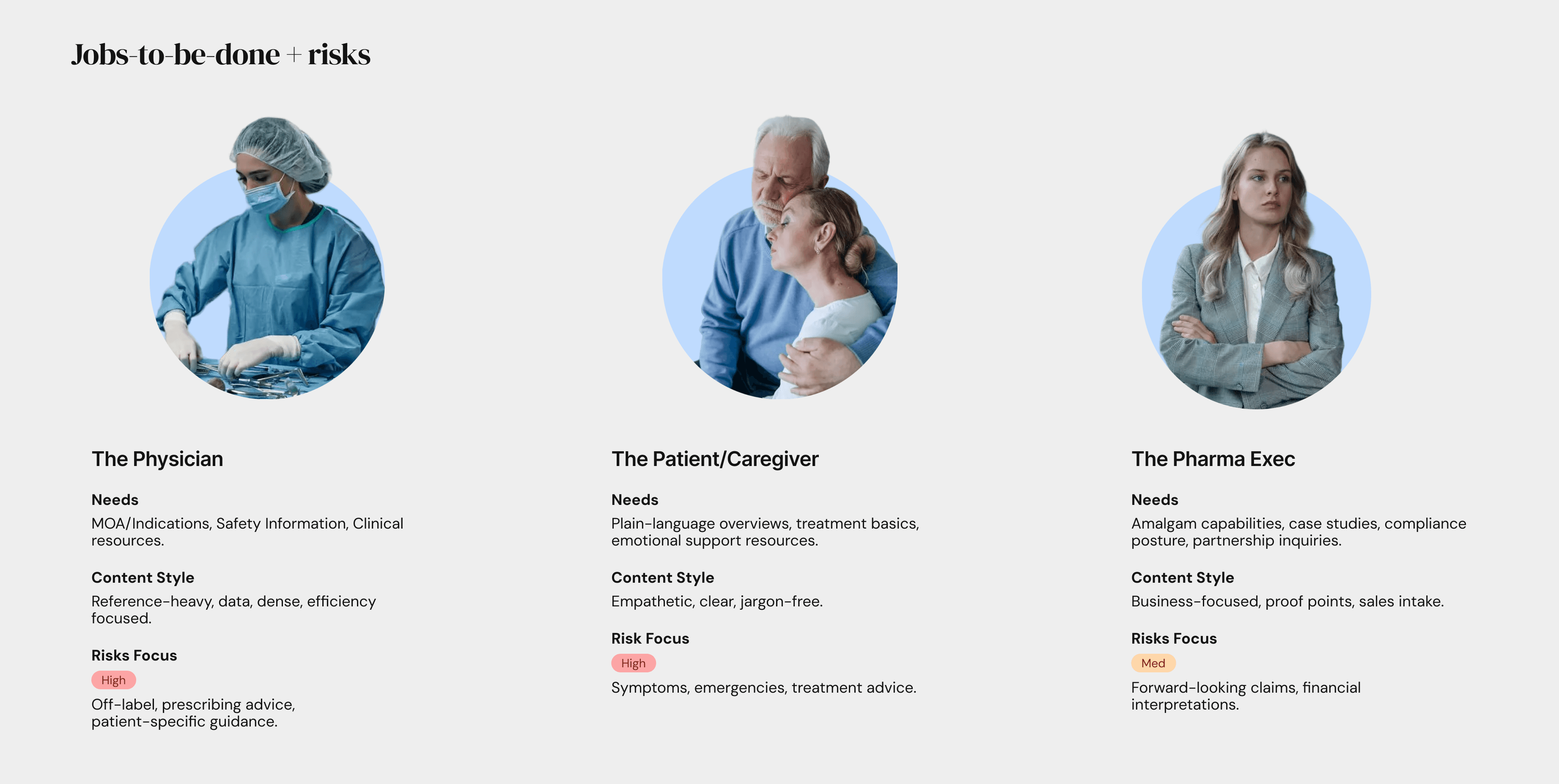
At the start of the project, I was provided a proof of concept LLM and conducted an audit of the overall experience. A key problem I found was: the experience was built around the data and not the users. I conducted research and created these user cards that highlight important JTBDs to identify where the proof of concept specifically fell short in user needs.
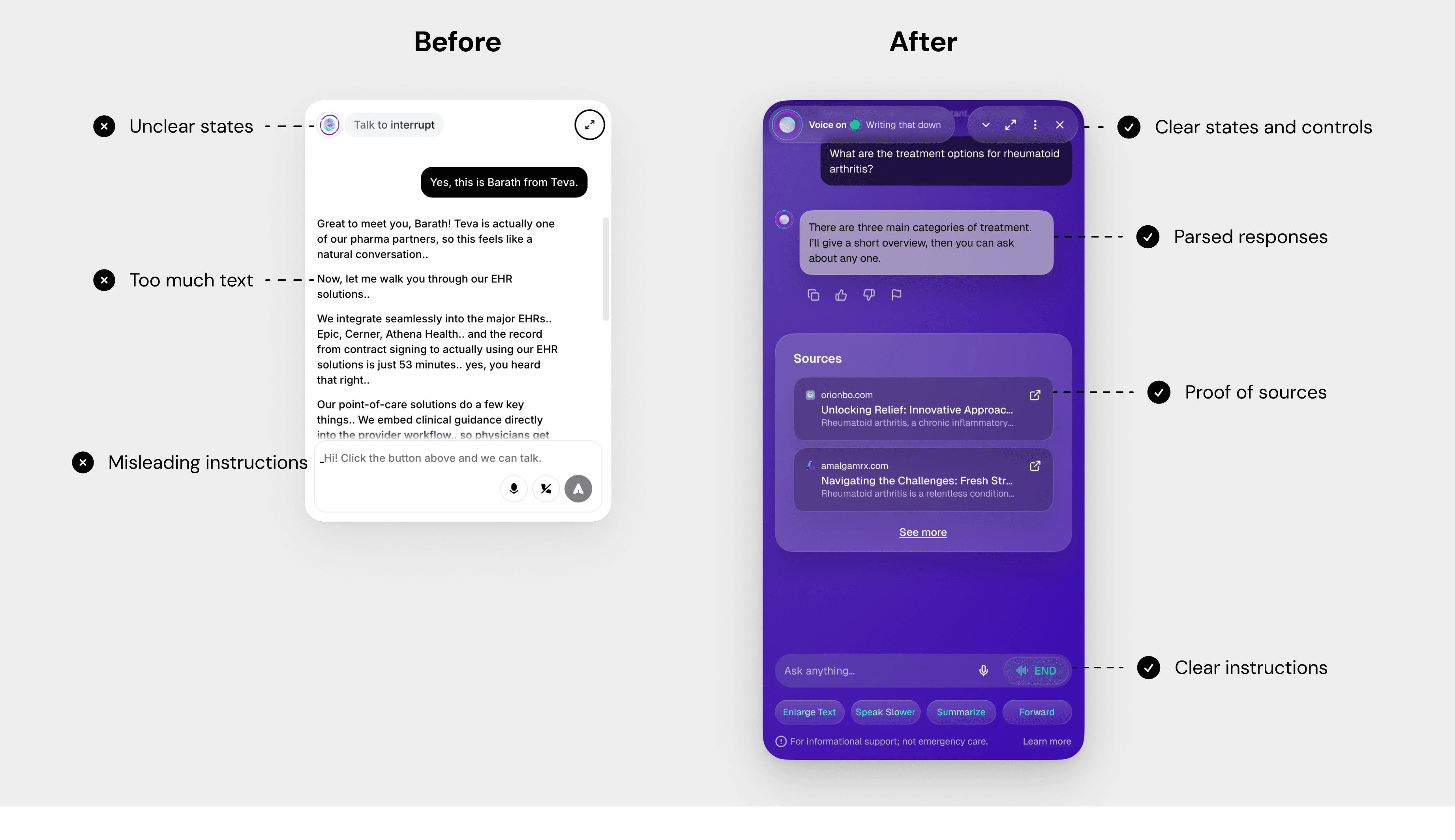
I discovered the following issues:
The Voice AI spoke too long and often to market a product on the website.
The conversation followed a linear format that focused on retreiving the user's information.
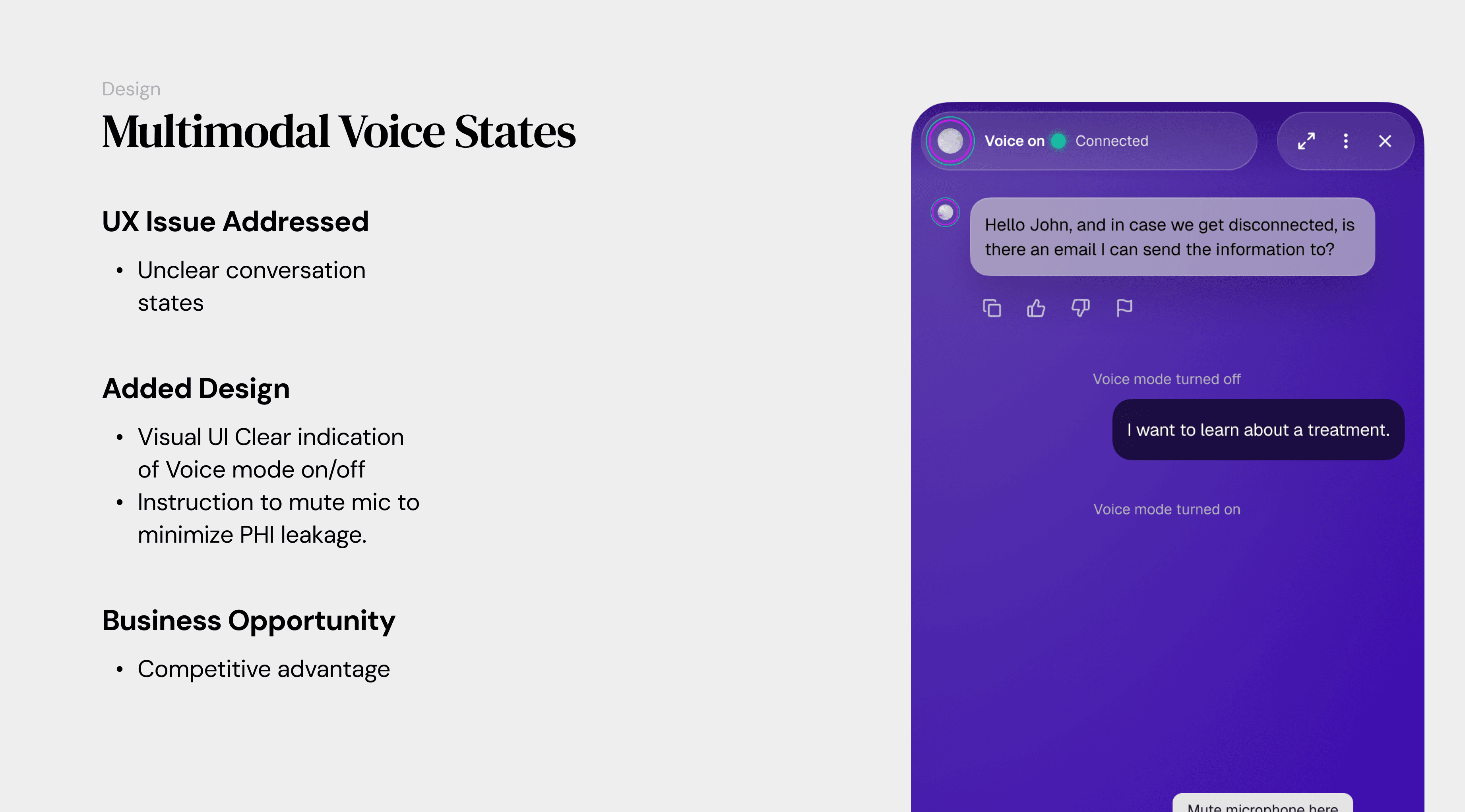
Voice mode is occasionally intrusive and insensitive to users who need long pauses.
Lack of clarification in wrong answers, implying high confidence in errors.
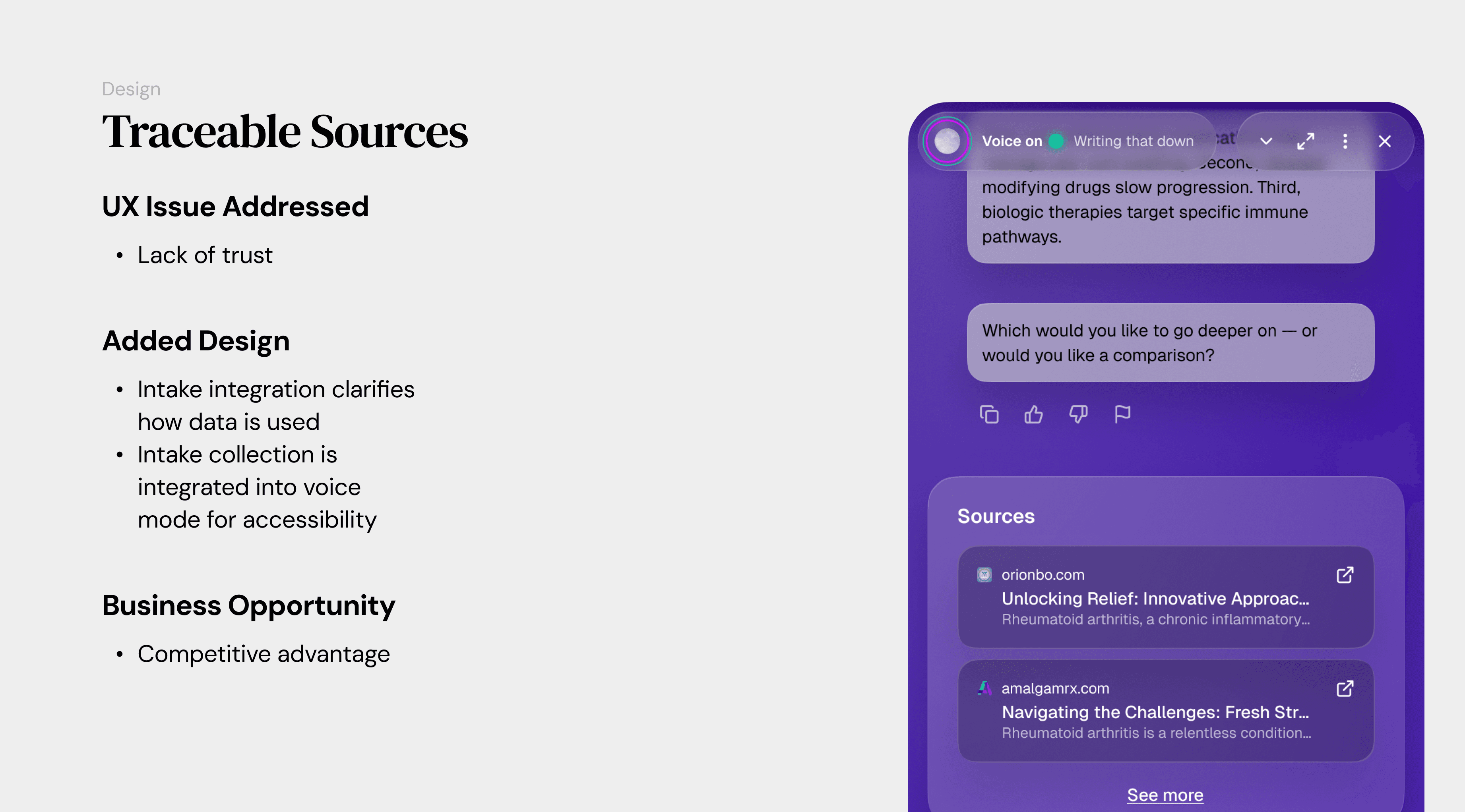
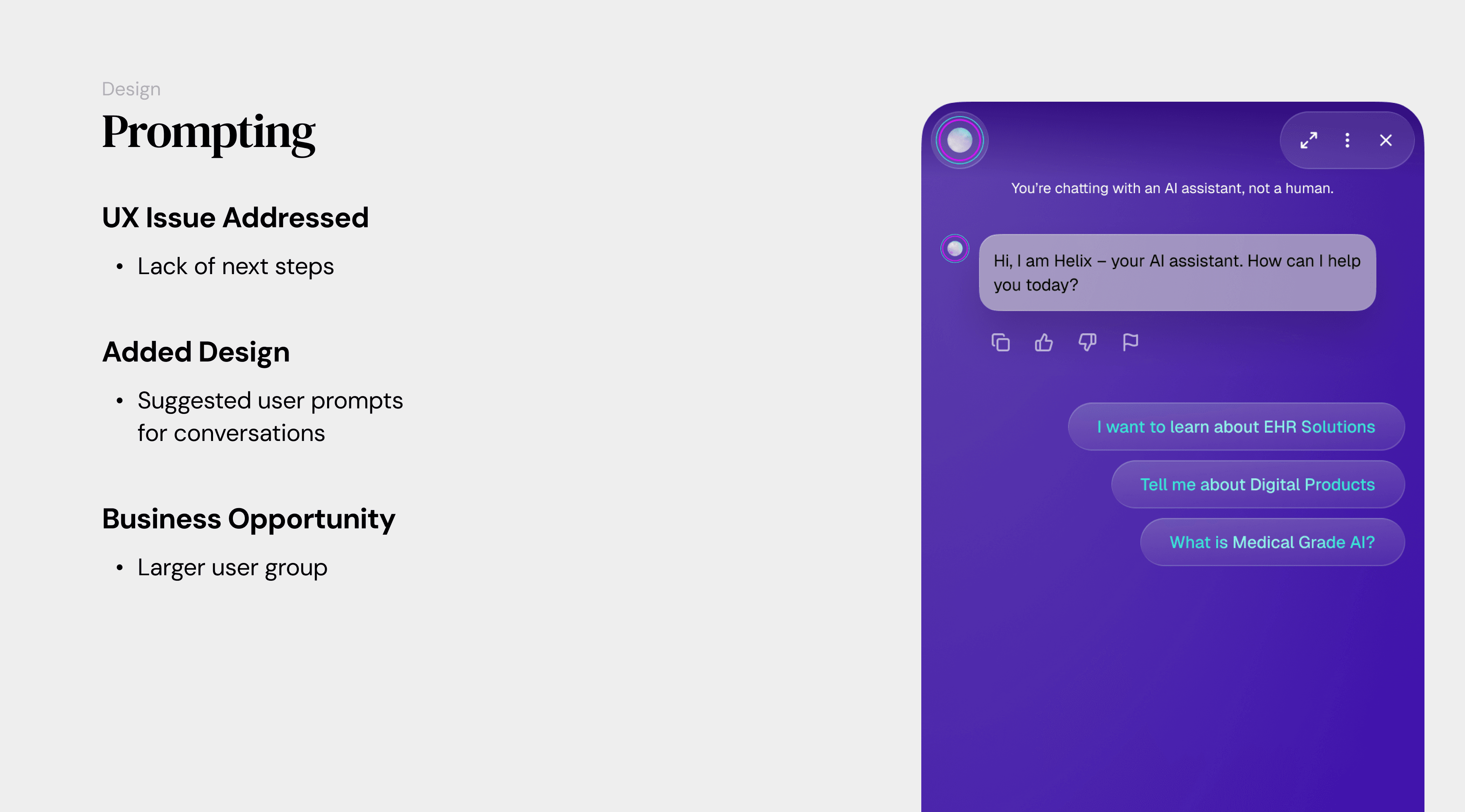
No sourcing of information or next steps suggestions.
Basic machine state UI was invisible to the user.
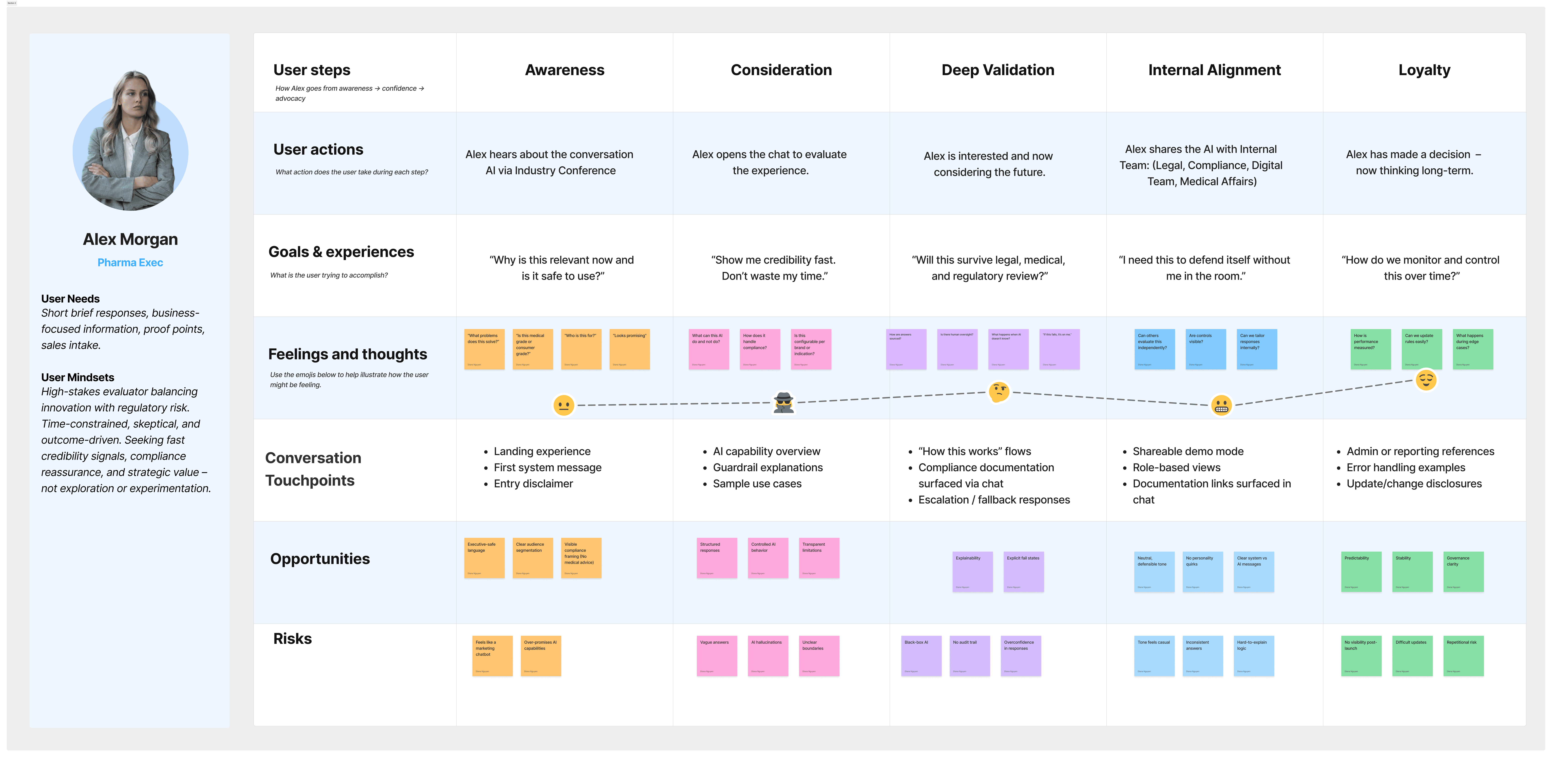
Prioritizing Fast Credibility, Legal, and Medical review.
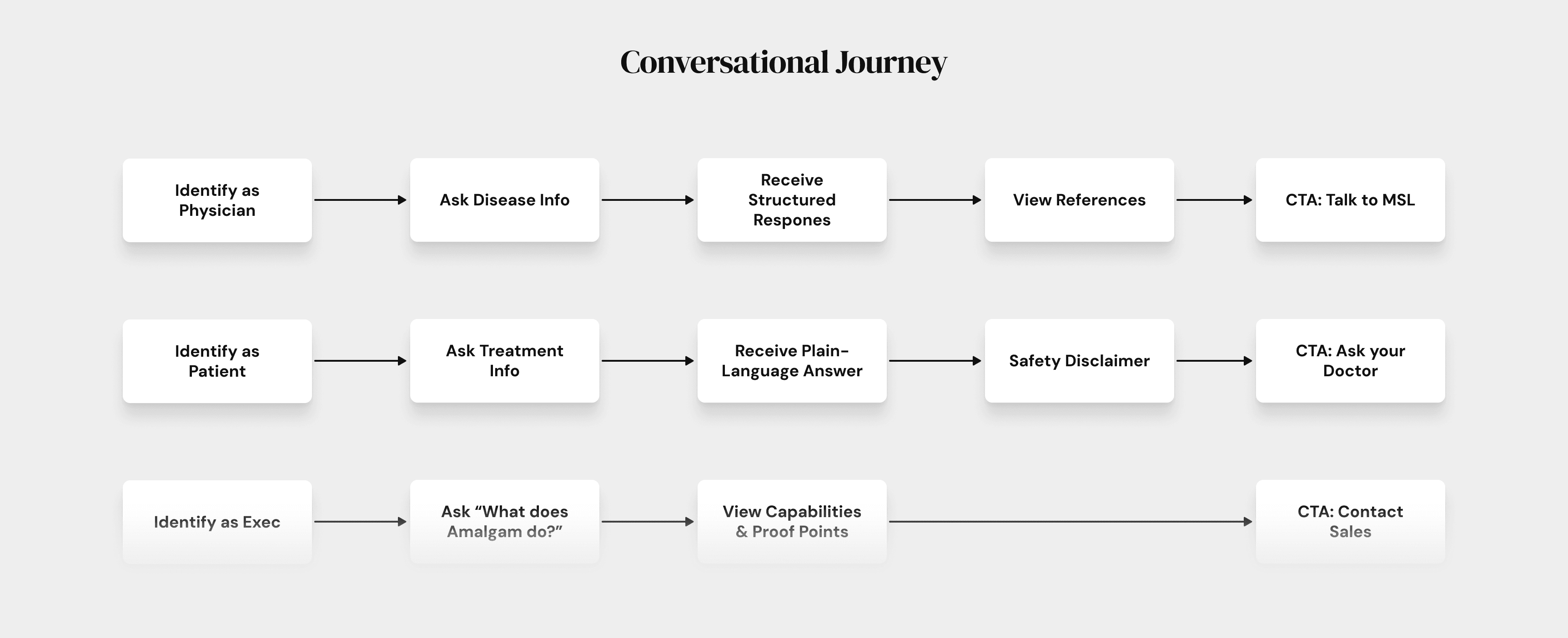
Because of the limited time, I mapped out the user journey of a Pharma Executive so to decide which user steps should I focus and found that Consideration and Deep Validation are the bottlenecks based off of the audit.
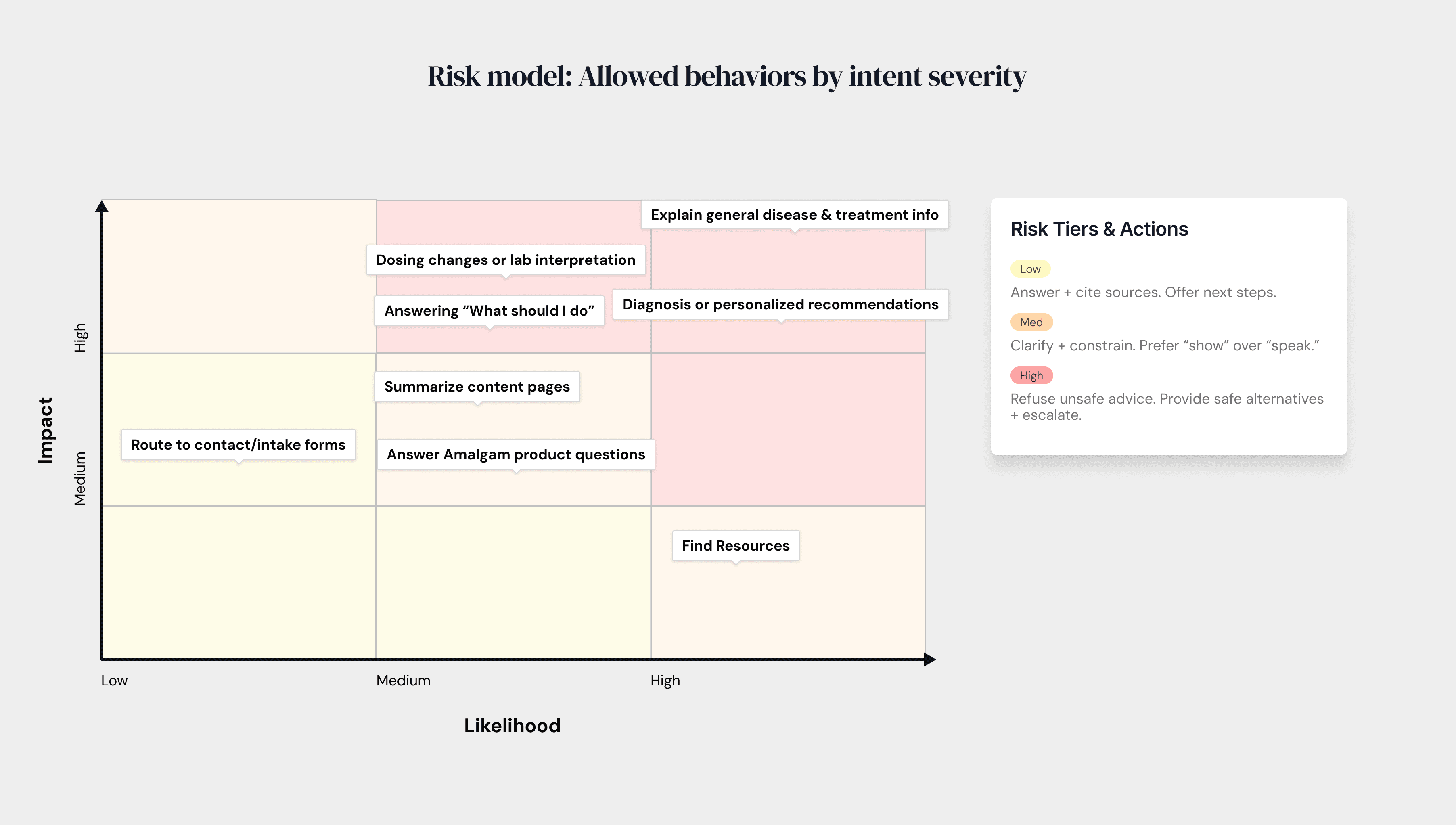
Determing Guardrail Behavior from User Prompts
Based off of questions the users would ask, we ranked them by risk levels to determine how the guardrails will behave. While dignosing and dosing answers are out of the question, advice on navigating health care providers and resourcing was okay.
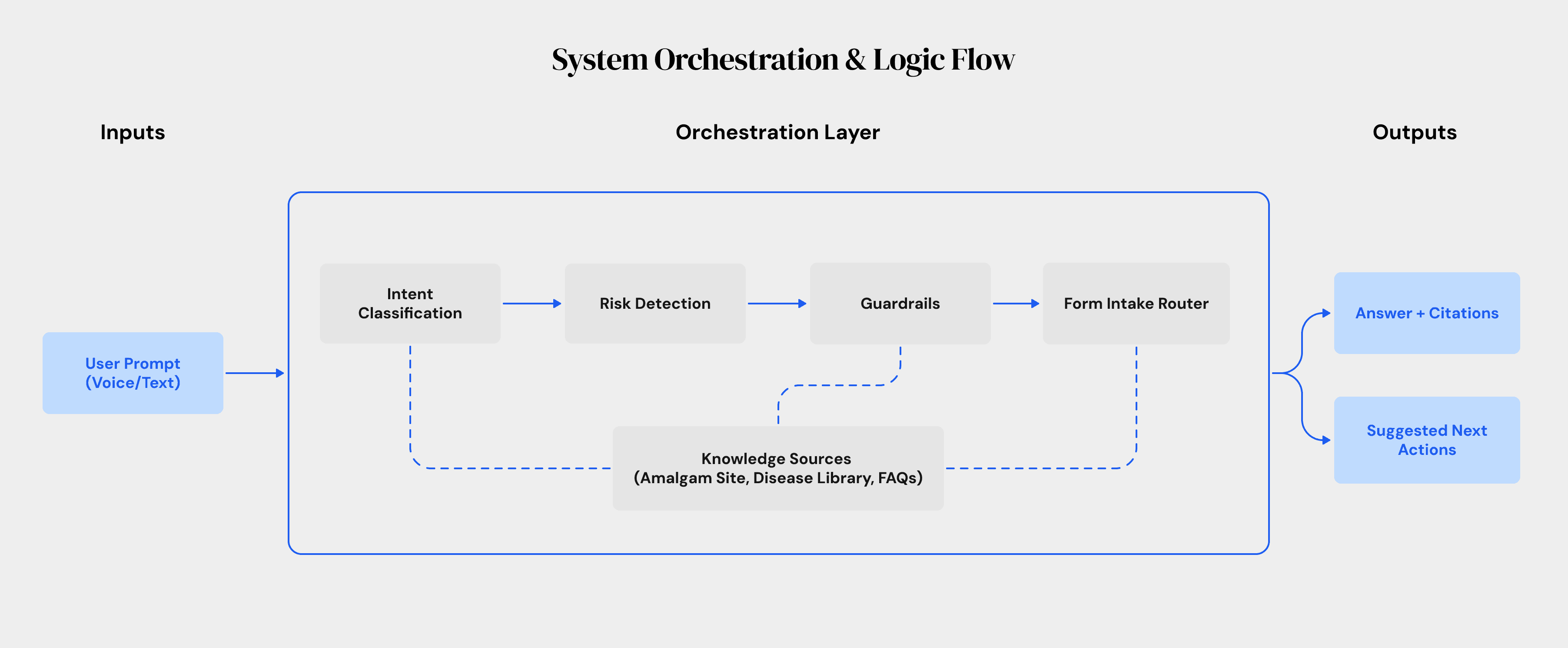
System Orchestration & Logic Flow
From the research, I began to map out how the conversations could be improved and benchmarked the system with how best-in-class voice experiences handled data. This was to ensure the rest of the team was aligned and understood how everything connected.
PHI Minimization Stratedgy

Where Failure and Barge-in Comes In During Voice Mode
This helped me determine what the core and marginal flows were for the desgin.

Business constraints we designed against
Learnings
Customers do not want a “chatbot”; they want a clear path to a resolution, especially when the issue involves learning about a business, technology, or patient. One thing I’d like to change is for this project to be designed around the users rather than the data.
Conversation design needs to balance empathy with precision, because overly friendly responses can feel dismissive when the customer is frustrated. I’d like to explore the possibility of user temperament detection in human hand-off and whether that would be beneficial or create bias.
Multimodal support works best when each channel has a clear role: voice for urgency, chat for guidance, visuals for explanation, and agent handoff for complex decisions. Next steps is to collect how a large group of users interact with the chatbot and determine if they find the multimodal roles clear.
RELATED PROJECTS

